
In this issue: Looking back on COV&R’s 2026 annual meeting and ahead to 2027; publication news; four book reviews; and a new volume of the bibliography of mimetic theory.

Contents
Letter from the President: Nikolaus Wandinger, News from the COV&R Board
Editor’s Column: Curtis Gruenler, Publication and Partner News
Event Report: COV&R Annual Meeting 2026
Recordings of the Plenary Sessions
Bridge Builder Panel and Award
Theology and Peace Quarterly Speaker Series, September 3, 2026
COV&R at the American Academy of Religion, Denver, Nov. 21-24, 2026
COV&R Annual Meeting, Wellington, New Zealand, June 30-July 3, 2027
New Publication: Suzanne Ross, Changed for Good: The New Wicked Truth Study Guide for Small Groups
Julia Shinnick, Così fan tutte, An Opera of Mimetic Revelation by Isabel Díaz-Morlán
Mark Anspach, Revenge of the Scapegoat by Caren Beilin
Bibliography of Literature on the Mimetic Theory: Dietmar Regensburger, Volume 53
Letter From the President
News from the COV&R Board
Nikolaus Wandinger

This time, I only want to bring some news from the recent board and business meetings to the readership of the Bulletin.
The first term of myself as president ended, and Curtis Gruenler’s term as Bulletin editor ended, too. The board suggested that both persons should be re-elected to their offices by the Membership. The business meeting voted in favor of these nominations.
The second term of two Board Members, Erik Buys and Stephen McKenna, ended. The board thanked them for their contributions during the past four years and suggested as their successors Mack Stirling, who is an American independent scholar, and Hélène Cristini, who works at the International University of Monaco. The Business Meeting accepted and voted for these nominations. Congratulations to Mark and Hélène, who we look forward to working with.
For some time, COV&R has not elected honorary members to the board, as this is, according to our by-laws, “offered to members in recognition of their distinguished leadership. It is the highest distinction COV&R can bestow and shall be conferred rarely and only when an individual’s exceptional contributions have set an aspirational standard and/or are of lasting significance to COV&R.” This year the board received and discussed the nomination of worthy persons for this honor. The board deliberated and unanimously decided on four members who fit the category of honorary member, three of them former presidents of COV&R. But honorary membership is not something one receives for having been a good president alone, neither is the presidency a precondition, as one of our nominees hasn’t been president of COV&R. The four persons the board suggested have served COV&R beyond their official functions: some of them have organized two or even three conferences, they have to the best of their abilities attended many, if not all, COV&R conferences, and they have provided outstanding leadership both on the administrative and the academic level to COV&R’s scholarship, vitality, and relevance. They are:
- Sandor Goodhart, president of COV&R from 2003-2007, organizer of the conferences at Purdue in 2002 and 2021 and author of important works in mimetic theory, particularly in literature and Jewish studies. His input at COV&R conferences is always electrifying, and he is a notable Jewish voice in COV&R.
- Andrew McKenna, editor of Contagion from 1994-2006. He laid the foundations for our journal as indispensable to us and an important voice for discussing, criticizing, and exploring mimetic theory. Andrew is an important theorist of mimetic theory in philosophy and literature and has recently been a frequent and indispensable contributor to the Bulletin as a book reviewer.
- Ann Astell, president of COV&R from 2011-2015 and (co-)organizer of the conferences at Purdue in 2002, at Koblenz, Germany in 2005, and at Notre Dame University in 2010. The way she links mimetic theory with literary scholarship and Christian spirituality and theology has greatly enriched our discussions and has led to significant publications.
- Martha Reineke, president of COV&R from 2020-2024, (co-)organizer of the conferences at the University of Northern Iowa in 2013 and DePaul University in Chicago in 2026. Martie has been untiring in bringing forth new ideas for improving COV&R, including some new ones on the way that it is too soon to talk about here. She has also been a pioneer in the area of mimetic theory, feminism, and psychology.
After one conference is before the next. We are looking ahead and looking forward to Wellington, New Zealand.
Hope to see you there.
Niki Wandinger, President
Editor’s Column
Publication and Partner News
Curtis Gruenler

Call for papers: At COV&R Chicago this summer, my colleague Dennis Feaster and I got to be part of a panel, moderated by Grant Kaplan and also featuring Dominic Pigneri and Tyler Graham, that explored connections between sports and mimetic theory. Afterwards, Graham and Pigneri decided to co-edit a collection of essays on the topic. Currently, George Dunn and Ryan Smock have also committed to essays, and several others have noted likely contributions. Essays currently explore baseball scapegoating, Unified Sports, education and sports, esports, and even chess. The goal is 15-20 essays. Paper proposals should be sent to Graham.
New journal: Issue number 3 of the French Girardian journal Antigone is available here.
Bloomsbury Handbook: As announced in our previous issue, the forthcoming Bloomsbury Handbook of Mimetic Theory is expected to be available in February. For a complete list of chapters and contributors, see here.
Book discount: COV&R members can receive a 20% discount on recent books from two series published by Michigan State University Press: Studies in Violence, Mimesis & Culture and Breakthroughs in Mimetic Theory. This includes the most recent title, Così fan tutte, An Opera of Mimetic Revelationby Isabel Díaz-Morlán. In addition, a 30% discount is available on selected titles from the backlist with a purchase of three or more. For the link to a page with more information about available discounts and how to order, please contact COV&R’s webmaster, Maura Junius. The same page includes a discount code for ordering through Eurospan, which has better shipping rates when ordering from Europe than ordering directly through MSUP.
The new volume of Contagion will be available imminently. An announcement with instructions for access will be sent to members separately.
Theology & Peace has a new website with a new tagline, “Making hope contagious…because peace takes practice,” and links to information about upcoming events, recordings of past events, and much more.
New read-aloud: The read-aloud-and-discuss Girardian Zoom group will start a new book on September 14, James Alison’s recent You Can, If You Want To: Navigating Christian Faith, Conscience and Matters LGBTQ+. Meetings are Monday nights from 7 to 8:30pm Central Time, with optional pre-reading chat beginning at 6:30pm. If you are interested in participating, please email Julie. Newcomers are always welcome.
Event Report: COV&R Annual Meeting 2026
Being in the Loop Together
Curtis Gruenler
To paraphrase Psalm 133, how good and pleasant it is when friends through mimetic theory dwell together in colloquy! One of the COV&R board’s actions this year was to reaffirm that our annual conference will continue to be held in person, and this year’s conference reaffirmed for me why that is such a good thing.
This year’s theme, “In the Loop of Mimetic Desire: Theatre, Art, and Architecture in Chicago,” took full advantage of our site. The plenary sessions that filled the middle two days were bookended by staged readings featuring local theater talent. Thursday began with a modern reimagining of the story of the sacrificial victim Iphigenia from ancient Greek drama as if she were on a talk show promoting a book telling her side of the story, and Friday afternoon finished with a two-man show about partners in the Chicago police caught up in a situation that forces them each to choose between scapegoating the other or self-sacrifice. Discussions afterward brought to the surface mimetic insights about, for instance, the toll American law enforcement takes on cops. At the same time, the violence that the plays illuminate was answered by the audience’s experience of letting our imaginations be carried by talented actors and thinking together afterwards about what the performances meant. We shared a unity not of violence but of contemplative and playful attention.
In between the performances, we heard a pair of talks about visual art on Thursday and, on Friday, a pair about architecture, each pair offering contrasting approaches to their subjects.
In her magisterial Girard lecture, board member Tania Checchi took on the question of a Girardian aesthetics in the broadest terms, with reference to dance as well as visual media. If, as she suggested, “there is a vestige of violence in every image,” her lecture mediated participation in something more transcendent, an act of beholding more like beholding a face. This was followed by the opportunity to consider a single visual work, Raqib Shaw’s remarkable, 100-foot wide painting “Paradise Lost,” first through an illustrated lecture by Madhuvanti Ghose, curator of the gallery at the Art Institute of Chicago where this remarkable work is on display through Nov. 15, and then by crossing Michigan Avenue to see the work itself and talk about it with each other. I had seen the painting before and found its vivid visual enigmas to be quite “in your face,” as Ghose put it, and a little off-putting, but came away from this two-stage viewing with a new appreciation for what could come from seeing it through the eyes of an expert appreciator and facing it together.
The architecture lectures began with Francis Morrone’s lively consideration of all of Western architectural history—no kidding—from a mimetic perspective focused on the early-twentieth-century shift from pre-modern styles, “architects imitating architects imitating antiquity” as he put is, to modern styles, “architects imitating architects imitating architects.” As if in response to the problem of architectural fashion’s runaway mimesis, Ivan Blečić and Emanuel Muroni took up the question of how mimetic theory helps understand the production of space itself as an object of mediated desire. What, they asked, does triangular desire do, not just to the rivals for an object, but to the object itself, and in particular to space as an unusual object that is not simply possessable. They shared their methods for investigating site-specific processes that happen beneath conscious awareness, which include experiments with installations in public spaces that invite people to play with possibilities other than rivalry. Ivan and Emanuel are part of the team that has proposed to host COV&R’s 2028 meeting in Cagliari, and I look forward to experiencing these urban spaces of desire in person.
Right in the middle of the conference, Friday morning, we heard the three winners of this year’s Raymund Schwager Memorial Award for the best papers given by graduate students:
- Third prize: Raymond Dokupil, “The Participatory Surrogate Victim: A Dialogue between Girard and Owen Barfield”
- Second prize: Isaak Hovet, “The Crowd in the Pulpit: Crisis Liturgy and Mimetic Escalation After Charlie Kirk’s Death”
- First prize: Sebastian Crossian, “The Contagion Movement: Mimetic Desire and the Scapegoating of Internal Migrants in India.”
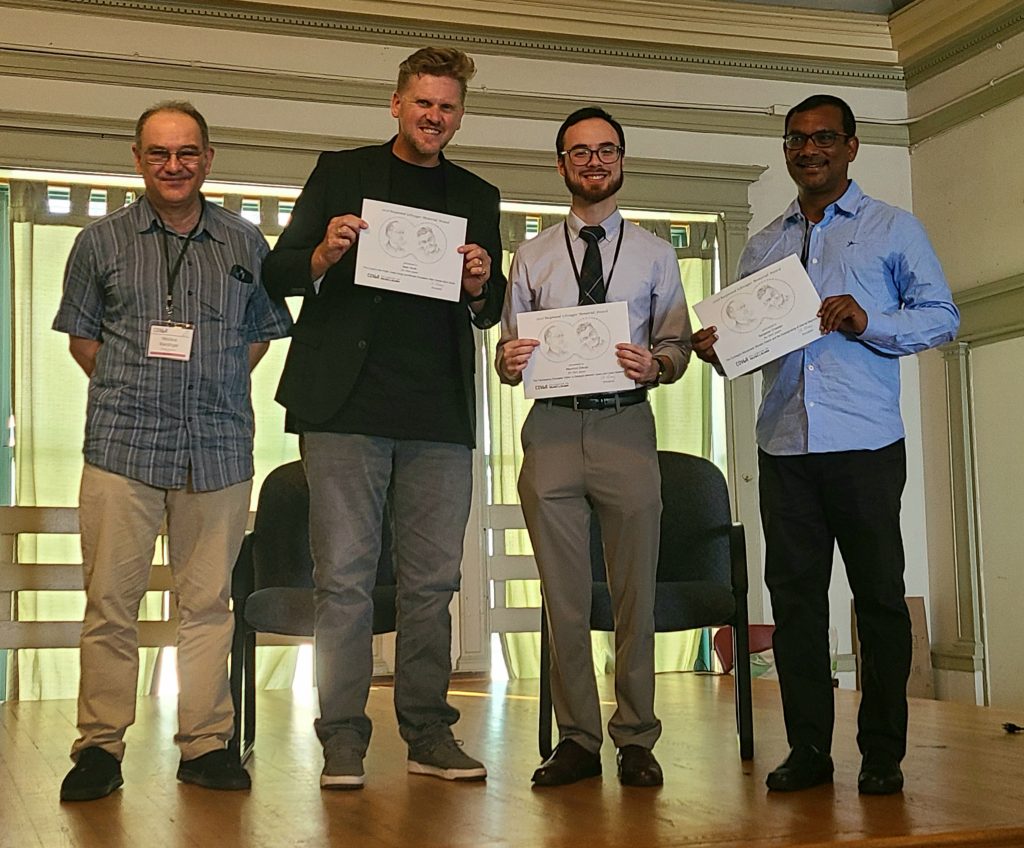
Left to right: COV&R President Nikolaus Wandinger, Isaac Hover, Raymond Dokupil, and Sebastian Crossian
Their talks could hardly have been more different in subject matter (or style of delivery), but each was a persuasive, insightful extension of mimetic theory. It was a delight to hear and celebrate such promising scholars.
The concurrent sessions on Wednesday and Saturday addressed, as usual, a wide range of topics pertaining to mimetic theory, many inspired by the conference theme. Thanks to those who volunteered to moderate. All of the sessions I attended allowed plenty of time for discussion that felt like a real sharing of thought—something that happens more often at COV&R than at any other conference I go to.
An opening plenary on Wednesday, the Raven Foundation Lecture by David Anderson Hooker, “Unveiling Conflicting Narrative through Transformative Community Conferencing,” initiated a series of practice-oriented sessions, including a Practitioners’ Lunch on Saturday hosted by Mack Stirling. Mack writes:
Thirty practitioners shared an extremely enjoyable lunch on Saturday at COV&R in Chicago. Many were attending COV&R for the first time. There were representatives present from Theology and Peace, Street Psalms, and Sharing Sacred Spaces. All present were unanimous in saying how much they had enjoyed the meetings, both the talks and the new friendships they were making. We join with everyone else in expressing gratitude to Martha Reineke and Maura Junius. The only regret was that there was not more time for social interaction. Thus, the group recommended that, whenever possible at COV&R, meals be taken together and that there be a common area set aside for informal conversation and meeting new people. The COV&R board has voted to make the Practitioners’ Lunch a regular part of the yearly meeting, and so we look forward to many such uplifting occasions in the future.
One of the concurrent sessions featured the inaugural Bridge Builder award (see separate feature).
Running through all of the program, filling its spaces, were conversations with friends old and new, some that have been continuing for many years, others begun only here and now. Some have also continued at a distance in between, and others I hope will do so, but this is no substitute for meeting face to face and sharing sacred, creative space.
Ps. 133 continues about dwelling in unity, “It is like the precious oil on the head, / running down upon the beard, / on the beard of Aaron, / running down over the collar of his robes” (New Revised Standard Version). Oil is for anointing, Aaron is a priest, and the robes are his priestly robes. Here, however, this is a metaphor or image for something less tangible that happens through being together. Surely the unity is a unity of peace, of shared desire for the fellowship of individuals in communion, rather the undifferentiation of rivalry or the unanimity of scapegoating. The next and last verse envisions this anointing, under the figure of dew, spreading as the blessing of God for abundant life to the temple city of Jerusalem. This year Chicago was our Jerusalem; may the anointing for a life of communion be with us each where we dwell.
*****
Your Opportunity to Access Recordings of the Plenary Sessions
One of the enduring challenges of an international organization is that not everyone who wishes to attend our annual meeting is able to do so. This year, we are pleased to extend the reach of the conference by making recordings of the plenary sessions from the 2026 Annual Meeting available online.
Our Chicago conference explored the theme, In the Loop of Mimetic Desire: Theatre, Art, and Architecture in Chicago. Rather than treating these themes abstractly, the plenary program paired practice with theory, inviting participants to consider how mimetic desire shapes the worlds we inhabit and create.
The collection includes:
Theatre
- “Elektra and the Mimetism of Revenge—A Performative Tale,” a lecture by playwright Emilio Williams, an award-winning writer, translator, and educator whose work explores experimental dialogues with literary traditions.
- A reading of an acclaimed Chicago play exploring love, rage, loyalty, and violence on the streets of Chicago featuring Chicago actors Johnny Garcia and Robert Tobin. Followed by a panel discussion with the actors, Andrew McKenna, and Betsy Hansbrough.
Visual Arts
- The René Girard Lecture, “Idolatry and Aesthetics: The Sacred Refashioning of Space and Time,” by Tania Checchi, Professor at the Universidad Iberoamericana in Mexico and a leading scholar of aesthetics, phenomenology, and mimetic theory.
- “Paradise Lost by Raqib Shaw,” lecture presented by Madhuvanti Ghose, Alsdorf Associate Curator of Indian, Southeast Asian, and Himalayan Art at the Art Institute of Chicago. Ghose introduces Shaw’s monumental twenty-one-panel Paradise Lost, tracing a journey from the artist’s childhood in Kashmir through the modern art world toward a fragile renewal.
Architecture
- “Architectural Style, Mimesis, and ‘Pastiche,’” by Francis Morrone of New York University, author of thirteen books on architectural history.
- “The City of Desire: Mimetic Theory and the Production of Space,” by Ivan Blečić and Emanuel Muroni of the University of Cagliari, exploring how mimetic theory can illuminate the ways human beings shape—and are shaped by—the spaces they inhabit.
In addition, the video collection includes a special lecture sponsored by the Raven Foundation:
- “Unveiling Conflicting Narratives through Transformative Community Conferencing,” by David Anderson Hooker, Founder of CounterStories Consulting, examining practical approaches to conflict transformation and restorative practice.
Whether you were unable to attend the conference, wish to revisit presentations that particularly resonated with you, or would like to introduce colleagues, students, practitioners, and friends to the richness of contemporary work in mimetic theory, we hope you will take advantage of this opportunity. Conference attendees receive access to the videos included in their registration fee.
The recordings are available for $49, with proceeds supporting the costs associated with making these presentations accessible to a wider audience. More importantly, this initiative reflects COV&R’s commitment to extending the conversation beyond those able to gather in person and to making the insights of mimetic theory available to new audiences. The videos will be available to a limited group on October 1, 2026 until September 30, 2027 when they will become publicly available.
If you know someone who has wondered what happens at a COV&R conference, this collection offers an excellent introduction. We encourage you to share this opportunity widely.
Purchase access to the plenary collection here.
*****
Bridge Builder Panel and Award
Martha Reineke

A panel discussion at COV&R’s annual meeting featured three members who are leaders in translating mimetic theory into practices that positively shape communities and lives. Mack Stirling, Vanessa Avery, and Felipe Vianna demonstrate in professional, creative, organizational, and community settings that mimetic theory offers powerful insights into conflict, relationships, institutions, and the possibilities for transformation. In COV&R, we describe our members who have taken this path as practitioners of mimetic theory.
Each practitioner on the panel attested to the varied ways in which mimetic theory can be translated into practice: leadership in adult religious education, leadership in a nonprofit organization devoted to building relationships across faith communities, and creative work in playwriting and literature. Together, they demonstrated how practitioners are bridge builders extending the influence of mimetic theory beyond the academy. They also are models, in a positive rather than rivalrous way, for others seeking to integrate mimetic theory into their own professional and community lives.
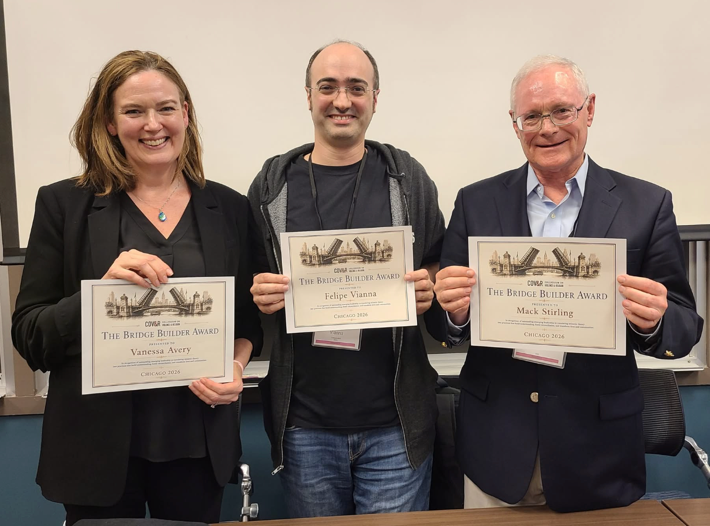
Mack Stirling
Originally from St. George, Utah, Mack graduated from BYU in chemistry in 1975. Along the way he served a two-year Latter-day Saints (LDS) mission in Norway and later married Dixie McRae just as she completed her nursing degree. They are the parents of four daughters and thirteen grandchildren. After medical school at Johns Hopkins, Mack underwent eight years of surgical training at the University of Michigan. Following three years on the surgical faculty at Michigan, he founded the cardiothoracic surgery program in Traverse City, Michigan, in 1990, which he directed until retirement in 2017.
In 1996, Mack was captivated by mimetic theory, especially its theological implications, working persistently thereafter to propagate and teach the ideas of René Girard. Most of his efforts have been aimed at his fellow LDS believers. This has included organizing multiple seminars with Gil Bailie, James Williams, and Tony Bartlett and publishing a number of papers on mimetic theory, mostly for LDS audiences. Mack also taught a course on the Old Testament from 1998 to 2001 for forty people, using Girardian thought as the primary interpretive method. He continues to teach and write on mimetic theory, often collaborating with Tony Bartlett.
Vanessa Avery
Vanessa is a religious studies scholar, interreligious peacebuilder, and the Executive Director of the award-winning national nonprofit Sharing Sacred Spaces. Her work has long focused on religious literacy, inclusion, and peacebuilding. In 1998, she founded VAST Consultants, pioneering education and training programs to help workplaces, universities, healthcare systems, and corporations better understand religious diversity and create more inclusive organizational cultures.
Vanessa began working on the idea of Sharing Sacred Spaces in 2017 and co-founded the nonprofit in 2020 after years of research, program development, and impact evaluation. She infused the organization with a distinctive approach rooted in community-building, spiritual hospitality, and ontology, helping communities transform division and “othering” into the radically altered perspective of our shared humanity.
Her approach is deeply indebted to René Girard and mimetic theory, beginning with the insights she gleaned from her Girardian reading of Jewish scripture and ritual as “peace vaccines”: narratives and practices that reveal and interrupt rivalry, fear, and othering, while cultivating humility, responsibility, wholeness, and shared blessing. Moving from there to world religions, mimetic theory is integrated throughout her religious literacy and peacebuilding work, including as an approach to depolarization.
Vanessa’s interreligious leadership has been accompanied by academic appointments at Yale Divinity School, Hartford International University for Religion and Peace, Webster University, and California State University.
Felipe Vianna
Felipe Vianna is a Brazilian comedy writer based in Rio de Janeiro. Trained in film and television, he first encountered questions that would lead him to mimetic theory through a longstanding interest in myth, psychoanalysis and literary criticism, particularly the works of Sigmund Freud and Northrop Frye.
Since discovering René Girard’s work, Felipe has sought to translate mimetic insights into his creative practice. His first presentation at COV&R, Hope beyond Religion: The Scapegoat in Animated Films, examined the progressive revelation of scapegoat structures in contemporary popular culture. In television writers’ rooms, he has found mimetic theory to be a powerful tool for understanding, not only conflict and character dynamics, but also the dynamics of the writer’s room itself—the processes of artistic collaboration through which new stories emerge.
Felipe’s current theatrical project, Oedipus Unrepented, is an example of this effort to bring mimetic ideas into artistic form: a comic reimagining of the Oedipus myth that explores what might happen if its protagonist refused the path of repentance. Across criticism, storytelling, and creative collaboration, Felipe seeks to build bridges between mimetic theory and the everyday worlds of artists, audiences, and cultural practitioners.
The Award Ceremony and the Future of the Award
At the conclusion of the panel discussion, each panelist received a new award funded by Suzanne and Keith Ross’s Raven Foundation: the Bridge Builder Award. In bringing the insights of mimetic theory into their professional lives and communities, the panelists are making connections that strengthen their work and also enhance mimetic theory by underscoring its value in many different settings.
Suzanne Ross from the Raven Foundation and Kris Rocke of Street Psalms distributed the inaugural Bridge Builder Awards. On behalf of COV&R, moderator Martha Reineke expressed gratitude for Raven’s funding of this award, which makes it possible for COV&R to celebrate the importance of practitioners to the future of mimetic theory and to support the award recipients’ ongoing professional growth, leadership, and mentorship of others.
The COV&R Board has accepted, with gratitude, Suzanne’s offer to fund the Bridge Builder Award for five years (2030) and Martha Reineke’s offer to fund the Award for another five years (2035). Mack Stirling, who has joined the COV&R Executive Board, and Martha Reineke will assume responsibilities for developing formal protocols for the award.
Forthcoming Events
Theology and Peace Quarterly Speaker Series: Contaminating Peace with Billie Hoard and Paul Hoard
Online
September 3, 2026, 7:30-9pm ET
For more information and registration, see the full announcement on the Theology & Peace website.
COV&R at the American Academy of Religion
Denver, Colorado
November 21-24, 2026
Once again, COV&R is sponsoring two sessions. The times given below are tentative. The final schedule will be posted on the conference website.
Session I:“Mimetic Theory, Social Order, and the Question of Identity” (Saturday 9:30-11am)
This session brings together two papers that examine how social and cultural boundaries are constructed, maintained, and challenged.
- “Prison Differentiation, Mimetic Theory, and Dirty Compassion,” Chris Haw, University of Scranton. This paper combines pedagogical, moral, and sociological reflection on teaching mimetic theory in prison and using the theory, in turn, to examine both carceral and national social arrangements. It centers upon the dynamics of purity differentiation as a way to order and resolve chaos, and the conundrum of compassion toward those who are most reviled.
- “Rethinking both metaphysical foundations and anthropological realities: Bridging the Vattimo-Girard debate through the ‘loose ontology’ of Henza culture and the crossing of gendered binaries,” Colby Dickinson, Loyola University Chicago. This essay reframes the debate between Vattimo and Girard—between ‘weak thought’ and anthropological facts—through Okinawa’s Henza culture where identities are established through a ‘loose’ ontology. This ontology presents a mythical-metaphysical reality that structures male-female complimentarity, though also allowing individuals to cross genders for cultural reasons. This essay contrasts ‘loose’ ontology with the ‘strong’ ontologies of western culture/religion where individual identities are ‘fixed’. For his part, Girard defines cultural intelligibility through acts of exclusion (scapegoating), though when the ‘other’ is not a fixed entity—even if an anthropological fact—new possibilities appear for metaphysics in relation to identity. Susan Sered’s reading of Henza culture enables a reimagining of the nominalist-realist dispute replayed in the Vattimo-Girard debate, and provides a solution akin to Martin Jay’s ‘magical nominalism.’ We need neither get rid of metaphysics nor fully identify with it—something Girard had foreseen with profound theological consequences.
Session II: Scarcity, Rivalry, and Faith: Reconsidering Desire in Politics and Theology (Sunday: 9:30-11am)
This session brings together two distinct yet complementary approaches to desire, conflict, and faith. The first paper examines Peter Thiel’s Girardian critique of climate-centered political rationality, focusing on how narratives of scarcity may intensify mimetic rivalry and social conflict. The second paper offers a Kierkegaardian reading of The Brothers Karamazov, exploring the problem of faith through the relationship between Alyosha and Ivan.
- “Mimesis, Growth, and the Politics of Scarcity: Peter Thiel’s Girardian Critique of Climate-Centered Political Rationality,” Julius Trugenberger. This paper examines the elements of René Girard’s mimetic theory that Peter Thiel uses to question the prioritization of environmental politics in parts of the contemporary Western discourse. Recalling the main patterns of Thiel’s long-standing engagement with Girard’s thought, this talk aims at demonstrating that Thiel interprets climate politics not merely as a dispute over environmental facts, but as a structural reorientation of political desire toward managed scarcity. According to a Girardian framework, periods of stagnation or decline intensify mimetic rivalry as social actors compete for increasingly limited goods. Thiel’s critique, as reconstructed in my talk, suggests that political programs willing to accept economic contraction in the name of climate goals risk amplifying precisely these dynamics of envy, resentment, and rivalry. In such conditions, social cohesion becomes fragile, and political conflict is increasingly organized around moralized blame rather than productive cooperation.
- “The Brother’s Karamazov and the Problem of Faith, A Kierkegaardian Perspective,” John Steichen, Boston College. In conversation with Friedrich Nietzsche and René Girard, this paper develops an account of Kierkegaard’s the stages on life’s way and applies them to a reading of Dostoevsky’s The Brothers Karamazov, and especially to the relationship between Alyosha and Ivan Karamazov.
The preliminary program book for the whole conference is available here.
Annual Conference of the Colloquium on Violence & Religion:
Violence and Peacemaking at the End of the World
Te Whanganui-a-Tara Wellington, Aotearoa New Zealand
June 30 – July 3, 2027

Readers are invited to Wellington, New Zealand, for the 2027 annual COV&R conference from June 30 to July 3 at Te Herenga Waka, Victoria University of Wellington. The meeting will be hosted by staff from the VUW programmes in Religious Studies, Writing, and Education, and from Otago University’s Theology Programme.
Wellington is “the coolest little capital in the world” according to Lonely Planet, a vibrant city clustered around bush-clad hills and a sparkling natural harbor. The seat of government, Wellington is also the center of the arts, film, and creative industries, boasts of nearby native wildlife sanctuaries, and is close to world-class wine country. The city is a gateway to the country’s spectacular South Island.
The main conference theme for 2027 is “Violence and Peacemaking at the End of the World.” New Zealand’s geographical situation, antipodean and deep in the South Pacific, provides a unique vantage point for considering rivalry and evolving relationships between the two superpowers in the Asia-Pacific, as well as offering broader perspectives on neo-imperial conflicts and their escalation around the world. The country’s distinct bicultural partnership between indigenous Māori and European (or Pākehā) peoples, founded on the Treaty of Waitangi (1840), also bears witness to dynamics of both mimetic rivalry and reconciliation, and offers many insights for René Girard’s mimetic theory. Further sessions are planned around restorative justice, reconciliation, peacemaking, friendship, social and cultural identity, and spiritual formation.
Visitors to Wellington will find a variety of affordable accommodation options near the University, and can enjoy a walkable city, famed for its cable car, waterfront, national cultural institutions, and cafes, bars and restaurants—more numerous per capita than New York City.
A call for papers will follow in November or early December, and proposals on both the conference theme as well as other topics pertaining to mimetic theory will be welcome. Further information will be available on the conference website by early 2027, including details about travel, accommodation, travel grants, plenary speakers, and special programmes taking advantage of the rich offerings in and around Wellington.
In the meantime, for any questions, please email Matthew Packer.
New Publication
Suzanne Ross
Changed for Good: The New Wicked Truth Study Guide for Small Groups
Twenty years ago, I published the first edition of The Wicked Truth: When Good People Do Bad Things, which applied the insights of mimetic theory to the Broadway musical, Wicked.
Today, the story of two Witches—one good, one wicked—and an unrepentant Wizard scapegoating his citizens feels more relevant than ever. Our need for the mimetic insights about myth, scapegoating, desire, and escalating rivalry has only increased. Wicked continues to be a surprisingly robust vehicle for sharing those insights with audiences who have become weary of partisanship, reckless violence, and power politics.
The new edition of The Wicked Truth has been updated to reflect our current cultural and political moment and includes new features: Questions for Reflection after every third chapter in the book, and a downloadable study guide for small groups. You will soon be able to order your copy of the book and download the study guide at The Wicked Truth website: thewickedtruth.com. Sign up for the newsletter to be kept up to date.
Here’s how the study guide works: Over five sessions, participants are invited to explore conflict, scapegoating, and political violence in Oz and apply their insights to the problems they face in their own contexts. They return to this side of the rainbow, surprised to have discovered a path forward from the way things are, to the way they could be—a path that emerges organically from within their shared experiences with other participants.
If this sounds like something you’d like to offer your community, please consider leading a small group—I’d love to hear how it goes! To learn more about whether this study guide is for you, please join me for a live conversation via zoom on September 23.
Book Reviews

Love’s Entanglement: God as Nonviolent Relation and How That Brings the World to Peace byAnthony Bartlett
Eugene, OR: Cascade Books, 2026
219 pages
Reviewed by Bernard Perret
The reader is warned from the very first words of the introduction: “This is a book about René Girard wrapped up in a book about relation. It is a book about relation given its critical method by René Girard” (xxiii). Such an interlocking should not surprise those who know that Girard’s thought has been centered from the outset on human relationships. Starting from the seemingly simple idea that all meaning arises from relationships, this book marks a decisive step in Anthony Bartlett’s years-long search for a philosophical framework that would make the ethical and spiritual implications of mimetic anthropology more salient.
The central aim of the book is to elucidate the philosophical upheavals implicitly contained in René Girard’s thought and to draw out all their theological consequences. To be more specific, it involves grappling with the difficult question posed by the incompatibility between mimetic anthropology and the metaphysical substratum of traditional Christian theology—a question that René Girard never really addressed in a systematic way. Yet, in his major works, he made no secret of the philosophical framework underlying his anthropology: his work consciously participates in the spirit of deconstruction, that vast intellectual movement of the last century which attacked the foundations of metaphysics in the continuation of the Heideggerian break. Jacques Derrida, one of its leading figures, maintained close relations with Girard for a time. By describing the process of the emergence of language and culture from the primal experience of collective murder, Girard de facto historicizes human nature and undermines the foundations of a dualistic theological thought whose conceptual framework remains indebted to the metaphysics of Plato and Aristotle.
But then the question arises: what can replace metaphysics, the notions of soul, substance, and eternity? In Theology Beyond Metaphysics, Bartlett began to answer this question by drawing on semiotics—the theory of signs and language. If human language emerges from primal violence, then the task becomes examining how the Gospel’s message of nonviolence transforms human existence through the transformation of the “codes” and symbols embedded in language and culture. In his subsequent book, Signs of Change, he illustrated this idea through brilliant commentaries on emblematic episodes from the Old and New Testaments. He showed that the Bible is permeated by a tension between sacralized violence and the progressive revelation of a nonviolent God who allows himself to be discovered through encounters, human initiatives, and singular events. The semiotic approach allowed him to assert that this tension is inherent in the process of the emergence of new meaning, since it is not possible to suddenly reverse the way meaning is anchored to violence, nor to immediately recognize the face of a God foreign to this violence. The contradictory and sometimes shocking nature of biblical texts paradoxically gives them the capacity to transform from within a human culture marked by violence and to bring forth a new meaning.
But it was necessary to go even further, for, as Bartlett himself self-critically questions, “is not semiotics as a discipline too light a thing to bear the weight of the task, with questions reaching back to first causes, and eternity beyond” (136). The question here, then, is whether the central notions of Christian theology, and ultimately God, can be thought within a non-metaphysical framework. Love’s Entanglement tackles this ambitious undertaking. To this end, the main focus shifts from the notion of the sign to that of relation. Bartlett is well aware of the risk of turning the idea of relation into a new metaphysical concept, and it is to guard against this that he presents several concrete approaches to relation drawn from different domains of experience. From the very first chapter, he shows how notions central to human existence such as beauty and power refer to specific forms of relationships with the world and with others, and why the problematic incompleteness of these relationships calls for the idea of God as transcendent otherness and ultimate guarantor of the meaning of each relationship. A foundational conviction is thus immediately stated: “To believe in God is to be in a living relationship. A transcendent meaning of relationship, a relationship of transcendence” (2).
It is toward the end of the book, in the chapter entitled “Transcendental Relation, Relation in its Own Right” that we find the most elaborate synthesis of Bartlett’s proposition. In formulations of a great conceptual density, he strives to unite in a single concept the generative relation to the sacred victim and its subversion/transformation into the relationship to Christ. What he calls “transcendental relationship” is not an abstract notion but “an expression of the human condition arising out of fraught human experience itself” (147). By remaining on the ground of relational experience, we avoid falling back into philosophical abstraction, as Bartlett summarizes: “Relation arises from relation, not from its concept, and this is what distinguishes it truly from metaphysics” (164). Biblical revelation can be understood as the transformative process of the transcendental relationship, which means that its truly religious meaning is inseparable from its anthropological significance. Through his words and deeds, Jesus reveals himself as the ultimate transformative sign of human existence. In other words, “transcendental relation takes on an anthropological sense and a kerygmatic transformative sense, both at the same time!” (149).
To lend flesh and philosophical credibility to his innovative approach, Bartlett draws on the history of philosophy, Girardian anthropology, scientific epistemology, and, of course, semiotics. According to Saussure, the sign is a relation between a signified and a signifier, but Bartlett proposes instead following Charles Sanders Peirce, who goes further. For Peirce, the sign involves a third term, the interpretant, which must be understood as the generic element of a dynamic of meaning. The most direct interpretant refers indeed to other signifiers which contribute to fixing its meaning. The dynamic of meaning is therefore an endless process—one sign interpreting another throughout an infinite series of linguistic and cultural productions along all human history. Understood in this way, the semiotic approach establishes the relational constitution of meaning: everything can be thought of in terms of relation, from the material world to human existence and even God.
Holding fast to this thread, Bartlett undertakes a rigorous re-examination of the Western philosophical tradition, from Plato to Heidegger. The result is a striking picture showing the extent to which metaphysical thought inherited from Plato and Aristotle has permeated our worldview, from Newtonian mechanics to Christian theology. Drawing on the analyses of Paul Ricoeur, Bartlett underscores the pervasiveness of the paradigm of vision. The transposition of the visible to the intelligible has structured metaphysical thought since Plato, and Christian theology has conformed to this mold. We perceive reality as composed of separate entities and distinct substances, and we spontaneously think that this vision fits with its intimate nature. Hence the propensity to reason based on binary divisions between body and soul, the sensible and the intelligible, the earthly world and immortality.
Over the centuries, philosophy has emancipated itself from Greek metaphysics. One of the key moments is Kant’s famous “Copernican revolution.” By placing the organizing activity of the human mind at the origin of the stable structures of empirical knowledge, he began to put anthropology at the center of philosophy—the true, profound meaning of the shift brought about by his “transcendental logic.” In a bold and suggestive shortcut, Anthony Bartlett shows that René Girard’s theory of hominization can be seen as an “original transcendental logic” that describes in anthropological terms the conditions of possibility for human thought. For Girard, however, this original logic is not contained within the faculties of human mind. It proceeds from the founding event through which culture emerged from violence:
With Girard human thought has a definite punctual beginning. It was not simply the result of a steady accumulation of billions of synapses spontaneously combining into consciousness, still less an immortal intelligent soul somehow inhabiting a body. It was produced out of a primary event of shock (something Girard speaks of in terms of “catastrophe”) which impacts a group of developed hominids already capable of intense imitation, but not of abstract, linguistic, conceptual meaning. The trauma of intense violence and its sudden discharge and resolution created the first moment of abstraction, the first collective break with the immediate. It was literally a trauma of attention that does not refer to anything but itself, anything but the terror of the murder and the salvific unity that followed it. (50)
Alongside this anthropological thread, Bartlett follows the thread of existentialism that runs from Kierkegaard to Heidegger. With Kierkegaard, for the first time, relational life and the conditions of an individual’s existence become as crucial as objective knowledge for understanding the meaning of things: “With Kierkegaard an alternative realm of inquiry about truth is broached for the first time—existentialism is born” (17). But it is undoubtedly Heidegger who marked the clearest break with standard metaphysics. Although Heidegger’s language of Being still evokes metaphysics, Dasein clearly refers to the primacy of lived existence over abstract ideas, and this will be henceforth the only possible starting point for philosophy. From a Girardian perspective, it is even more crucial to observe that Heidegger’s “dynamic ontology” does not shy away from violence (29). His pre-Socratic genealogy of Greek thought reveals the primal violence contained in Heraclitus’s Logos, thus paving the way for Girard’s theory of the violent origin of language and culture. For Bartlett, even though Girard criticizes and “deconstructs” Heidegger by unveiling the violent sacred behind Being, one cannot ignore the fact that “Without Heidegger’s profound alteration to the canonical reference points for philosophy Girard’s own tectonic shifts could not have claimed authority, or gotten cultural purchase” (xxiv).
By venturing boldly into the realm of the “hard” sciences, Bartlett shows that classical science—Newtonian mechanics, typically—remained beholden to a vision of reality consistent with that which underlies metaphysical thought. From the Greeks to Einstein, representations of time, space, and matter have remained compatible with sensory and visual intuition. For Isaac Newton, the world is made up of distinct objects located in a specific place within an intangible geometric space, immersed in a universal, continuous, and imperturbable temporal flow. And these objects are connected to each other and set in motion by immaterial forces that do not affect their substance. The human subject, its constitutive relationality and its self-awareness, struggle to find a place in this description. Hence the radical dualism of religious thought—the immortal soul cannot be part of the material world.
But everything changed at the beginning of the last century with the twin revolutions of the theory of relativity and quantum mechanics. The representation of reality that has emerged for scientists shatters the framework of thought inherited from metaphysics. The flow of time depends on the observer’s movements, and elementary particles are linked at the level of their intimate structure, to the point that it is no longer possible to think of them as separate entities. The word “entanglement” refers to a precise physical phenomenon that dramatically demonstrates the relational nature of the physical world as revealed by quantum physics:
Two particles are connected because they have been part of the same quantum energy event (for example, atomic decay). They share information about each other, but that information can only be known when we look. We are somewhat familiar with this, but now there is another dimension. The particles can be separated by very large distances before the measurement is made, but, once made, the measurement of one instantaneously determines the state of the other. The state of one particle is determined by the state of the other—when we look. (109)
While being careful not to impose models from the hard sciences unduly onto human and social realities, Bartlett shows that the philosophical consequences of this new understanding of the physical world are decisive and far from being fully explored. At the very least, advances in contemporary physics lend credence to the idea that reality, in all its dimensions, demands to be understood through relationships rather than as an assemblage of separate beings and objects. In this light “‘entanglement’ is a trope which offers several levels of meaning, ending up with meaning as love” (111).
As an illustration of the ideas developed in the book, the final chapter is an exercise in semiological exegesis of the New Testament. The opening chapters of Mark, the Book of Revelation, and some of the emblematic parables of Luke’s Gospel allow Bartlett to highlight “the generative code that brings into history the transcendental relation of nonviolence” (166). A transformative pedagogy is at work, based on signs that provoke and question, calling for an interpretation that opens onto new meaning. Bartlett shows that this question of the interpretation of signs that raise questions is consciously thematized by the authors of the New Testament, in order to highlight the revolutionary nature of the perspective of human relations freed from violence brought by Jesus.
On every page of the book, the desire to place the transformative logic of evangelical nonviolence at the heart of the human present shines through: “We might say that the cross and resurrection become entangled with all other time, such that these ordinary moments break forward, not to the next linear moment of the clock, but to the apocalyptic renewal of time in the everlasting reality of peace and love” (179). To make this even more concrete and vitally engaging, the book concludes with an appendix in the form of a testimony to the community experience Bartlett has been leading for the past ten years with the Bethany Center for Nonviolent Theology and Spirituality—a testimony that resonates deeply with the message of transformation through and for the humanization of relationships that underpins his work.
All in all, this book opens up new perspectives for thinking about the relationship between anthropology and theology. René Girard himself always insisted on distinguishing his work from theology, even saying that, as an anthropologist, he had nothing to say on “the properly theological assertions of traditional Christianity, the redemptive value of Christ’s death, for example, or the Trinitarian dogma” (in “Réponse à Régis Debray,” a chapter added to Les origines de la culture, the French version of Evolution and Conversion). But this separation is made problematic by his interpretation of Gospel Revelation as the unveiling of a human truth accessible to reason—a perspective that gives concrete meaning to Simone Weil’s idea that “even before presenting a ‘theory of God,’ a theology, the Gospels offer a ‘theory of man,’ an anthropology” (Girard, I See Satan Fall Like Lightning, trans. James G. Williams, Orbis Books, 2001, p. 44). The rivalry potential of this dualistic approach to truth is all the greater given that Girard always tended to privilege mental representations—beliefs or knowledge—as the keys to the transformations brought about by religion. Yet, this conception of religion as a world of ideas is contradicted by his own analyses, which demonstrate the primacy of collective practices, rituals, and language itself as a concrete phenomenon arising out of original crises of violence rather than abstract cognition.
Girardian theology has certainly moved beyond this too conceptual interpretation of revelation. Drawing on Girard himself, theologians and scholars of religion have been able to suggest that mimesis itself is a central tool of religious development. James Alison incorporated the personal experience of conversion into the account of the theological process. As he conceives it, theology is not just a field of knowledge nor an institutional practice, because the theologian can only claim to know his object insofar as he is engaged in a process of personal transformation. His mission, then, is to clarify the language that accounts for this experience (see John P. Edwards, “James Alison’s Theological Appropriation of Girard,” in James Alison and Wolfgang Palaver, The Palgrave Handbook of Mimetic Theory and Religion, Palgrave Macmillan, 2017).
Bartlett goes a step further, demonstrating the linguistic-relational subsoil of human meaning and its hugely critical role in human change. His drawing attention to the fundamental network of relations and relationships that make up human reality has opened a vast field of inquiry equally crucial for both anthropology and theology. Inherited beliefs and scientific knowledge, as well as all the drivers of moral and spiritual life, need to be understood in the light of the specific relational experiences from which they arise, above all in connection to the generative function of violence. Bartlett’s contribution, then, is to insist convincingly on the intra-worldly transcendence of both violence and nonviolence. The gospel is never a set of abstract doctrines but a unique ferment of transformation at the roots of the human condition. By stating in this way that faith in God is to be considered a modality of “being in relationship,” Bartlett does not eliminate all tensions between a necessarily objectifying anthropology and a divine revelation rooted in the apostolic tradition, but he does provide a powerful frame of new insight including possibilities of authentic new syntheses of understanding.
Così fan tutte, An Opera of Mimetic Revelation
by Isabel Díaz-Morlán
Michigan State University Press, 2025
134 pages
Reviewed by Julia Shinnick
In Così fan tutte, An Opera of Mimetic Revelation, Isabel Díaz-Morlán provides a tour-de-force mimetic analysis of the Mozart opera that students of René Girard’s mimetic theory will find enlightening and fascinating reading. Díaz-Morlán certainly has succeeded in her stated purpose: “to ascertain whether these manifestations of human mimetic behavior can also be found in opera, in the same way that Girard discovered them in the classics of literature” (xi).
This opera is a perfect candidate for mimetic analysis, with its two sisters, Fiordiligi and Dorabella, engaged to two soldiers, Guglielmo and Ferrando. The young men accept the suggestion from the schemer Don Alfonso to test their fiancées’ loyalty by pretending to leave for war but then reappear in disguise as two “Albanians,” each of whom courts the other’s intended. Despina, the sisters’ maid and an accomplice of Don Alfonso, helps to persuade the young women eventually to succumb to the wooing by the two “Albanians.” The truth comes out in the final “reveal,” after which they reconcile with their fiancés, with all having learned they are not immune to temptation, while Don Alfonso, the instigator of the plot, is happy to have shown that “Così fan tutte” (“Thus do they all,” commonly translated into English as “Women are like that”).
As Díaz-Morlán recalls in her epilogue, Girard, in a 1972 essay on comedy, “takes a highly perceptive look at its capacity to reveal the truth” and argues that “comedy, and not just tragedy, is a very appropriate genre for unveiling the mechanism of mimetic desire” (108). Indeed, Girard argues in To Double Business Bound (125) that “the crisis element is more acute in laughter than in tears.” Díaz-Morlán points out that “laughter functions in comedy as a mechanism of expulsion, and a rejection of the person the group is laughing at and generates purification” (108). Within comedy, this purification is experienced by the characters who have suffered the consequences of their own actions, the ultimate revelation of the truth of their desires, as is evident in the ending of Così fan tutte.
In chapter 1, Díaz-Morlán provides a thorough background of how the opera came into being and why it was not at first accepted by the public and critics, “possibly because in the nineteenth century . . . the romantic lie held sway” (50). The next two chapters familiarize readers with the story line and structure of the opera and give a thorough treatment of the libretto’s thirty-one possible literary sources—from Hyginus’s Fables (1 BCE) to G. B. Casti’s Il ritorno inaspetatto (published posthumously in 1804 but available earlier to Mozart and Da Ponte )—comparing them with Da Ponte’s libretto. She also discusses thematic textual motifs in Così fan tutte and compares them with classical sources.
Díaz-Morlán’s chapter 4, “The Novelistic Truth about the Mechanisms of Desire,” gives the reader an exceptionally lucid summary of the basic principles of René Girard’s thought on mimetic desire as found in his writings on literary works, especially Mensonge romantique et vérité romanesque (1961). Díaz-Morlán notes that Girard limited his attention to literary texts expressing novelistic truth (vérité romanesque) in which their authors “revealed that conflicts between human beings arise out of mimetic disease, from the impulse of mimetic desire” and that “desire can be stimulated by the model singing the praises of the object” (41); for example, “In Così, both the two friends and the two sisters proclaim to their doubles the numerous qualities of their lovers, thereby arousing in them envy or desire for the object possessed by the other” (41).
As Girard has argued about literary works evincing novelistic truth such as Don Quixote, whether comedy or tragedy, in the end the characters, readers, and/or audiences “obtain the cure for the disease, in that the hidden truth about the destructive power of desires is revealed to them in the pages of the novel or in the action that takes place on stage” (45). Così holds to this truth in “the double couples who are reconciled half ashamed, half repentant, in the firm conviction that ‘it is better not to do the test’ ” (45).
In chapter 5, the heart of the book, “Mimetic Revelation in Così fan tutte,” Díaz-Morlán deftly weaves evidence from her various sources into an excellent analytical and philosophical conclusion. Of special note here is the fact that Díaz-Morlán includes telling analysis and musical examples showing how the music itself, in Mozart’s inimitable way, contributes essentially to the revelation of mimetic desire. One of the many musical examples she gives, the first terzetto, “La mia Dorabella,” shows how “music can express the identity of the doubles, the first step towards achieving internal and double mediation” (55). In this passage, “Ferrando [a tenor] proudly praises Dorabella’s fidelity and beauty (bars 8-14); Guglielmo [a baritone] does likewise for Fiordiligi, singing to the same melody, as Ferrando (bars 14-22)” (56 ), but in a different tessitura and key (dominant for Guglielmo, as opposed to Ferrando’s statement in the tonic). Don Alfonso (a bass) completes the section with a return to the tonic, claiming “that he is right, ‘ex cathedra parlo’ (I speak ex cathedra), although the audience still does not know what he is talking about” (56). In bars 29-43 of the second part of the terzetto, the two friends sing alternately, in identical, parallel musical parts, and “ask Don Alfonso to prove what he has just said (that their lovers might be unfaithful, we now know). He advises them to do the test” (56). Towards the end of this number, “Mozart parodically underlines the excessiveness of the soldiers’ gesture by playing a fast, forte ascending scale on the violins just as the men are singing the word ‘spada’ (sword)” (57). The young men have expressed a determination to use violence (the sword) if necessary in the test, certainly an example of overblown rhetoric, appropriate as parody in opera buffa.
In another revealing passage, Díaz-Morlán posits that “Don Alfonso is preparing us for a full denial of the romantic ideal in amorous desire” (58). When Don Alfonso asks the two young men “whether their fiancées are goddesses or women,” Mozart sets their responses homophonically, reflecting in the musical texture their same initial opinion. They insist that “they are under no illusions; they know they are women” (58), but there is significant undermining of their words in the music itself. An unusual augmented fourth interval in Ferrando’s part, along with “the timid and slightly dreamy objections that the two men raise in the face of Don Alfonso’s stern realism, and above all, the way the melody unravels the dominant chord of the tone, which remains unresolved, indicates that the men’s identical adoration of their beloveds, however sincere it may seem, is empty, undefined, and incomplete” (58). This seems as if Mozart’s musical design is mocking the two friends’ shared adoration. In an actual performance of the opera, these musical gestures can be emphasized to good effect. Díaz-Morlán cites a recorded performance (Sir John Eliot Gardiner on the DG label in 1993) where the two singers extend the last syllable in such a way as to make the rapturous sentiment of the two friends look ridiculous and melodramatic.
The preceding is just a glimpse of the outstanding way that Díaz-Morlán unpacks and explains the various musical means and devices Mozart uses to underline and emphasize the mimetic themes of the text. She also discusses two camps of scholarly opinion regarding Fiordiligi’s aria di sortita, “the first important number she sings in the opera and her first solo” (95). Some consider the aria to be a parody of the serious style, “making fun of Fiordiligi’s expressed wishes to remain true ‘like a rock’ ” (95). Several see the aria as insincere, no matter how much Fiordiligi may want to believe what she is singing, in contrast to the following duet in which she finally yields.
Some scholars in the opposing camp argue that Mozart, even to the point of correcting Da Ponte, has created an aria that is in no way parodic and instead offers a genuine expression of sincere feeling, claiming that Mozart’s use of seria style here implies that “Fiordiligi is determined to be firm” (96).
Díaz-Morlán, advocates a “third way” of interpreting the aria, agreeing with another scholar, Andrew Steptoe (a prominent British psychologist and author of the highly regarded book, The Mozart-Da Ponte Operas). Steptoe argues that the stylistic changes in the aria may begin with caricature in its first two lines (referencing the “firm rock facing the storm”), but sees the next two lines as more intimate and personal because Mozart treats them more gently and fondly than the opening passages. In the reprise, according to Steptoe, the composer returns to the parodic style. Facing this question of style, Díaz-Morlán views the aria as a “generally serious piece with some parodic features” (96). Bringing us back to the various sources of the libretto, Díaz-Morlán next notes that some scholars, when judging that in this aria Mozart is parodying Fiordiligi’s determination to remain true, “are not taking into account the traditional fable or story on which the libretto is based, in which this scene needs to be serious” (97). Fiordiligi is at this point still “a victim of her own belief in the lies of immovable, romantic or absolute love” (97), and not conscious of her imitative, real desire to imitate Dorabella in desiring her “Albanian” suitor.
As Díaz-Morlán points out, in relation to Fiordiligi’s profession of faithfulness, “The bearers of desire are unconscious or unaware of their real desires, and they therefore express themselves as if these desires did not exist, even though their actions seem focused on achieving them” (97). The men, unaware that their real, underlying desire is to gain the love of their model’s fiancée, foolishly decide to enact the fidelity test, which is doomed to fail. And thus, notes Díaz-Morlán, “Così will not fall into the romantic lie, but will strive to reveal the novelistic truth, both in moments of parody and when we are privy to the expression, experienced as true, of feelings such as rejection, regret or passion” (97-98).
A typical comedy will conclude with a young couple or couples, having undergone various trials, mistaken identities, and the like, now happily united and destined to live happily ever after; the play has ended and the romantic lie seems fulfilled as true, with no test of fidelity having been encountered. Girard himself, in an early essay, “Marivaudage, Hypocrisy, and Bad Faith” (72), wrote, “We can be sure, of course that no such test is forthcoming, since the play is at an end.” But, says Díaz-Morlán, “Così begins where other works end, with two young couples seemingly destined to live happily ever after” (99), and proceeds with their happiness being shattered by the test. Although the opera does have its own “happy ending” with the original couples finally reunited, the sisters have failed the test, and the two men are embarrassed at having tested their fiancées. “No wonder the opera was rejected almost immediately after its first performance,” says Díaz-Morlán. “It was too real, too raw” (99). The characters of Così fan tutte are in some ways similar to those of A Midsummer Night’s Dream, who have undergone, as Girard wrote in A Theater of Envy (48), “a collective ordeal, and ultimately a kind of initiation ritual.” In Così fan tutte, a staged work, and particularly an opera, the ordeal of initiation has been set to music, which, as Díaz-Morlán has convincingly shown, contributes powerfully to the revealing of the romantic lie for its audience as well as its characters.
This book is an outstanding and significant contribution to scholarship on the mimetic theory, expanding the scope of Girard’s original analyses of purely literary texts into a new medium, opera. A place to begin examining the genre in terms of how musical techniques and settings support or enrich the mimetic theory might be with operas such as Verdi’s Macbeth and Otello, Gounod’s Roméo et Juliette, Thomas Adès’s The Tempest, Benjamin Britten’s A Midsummer Night’s Dream, or Bret Dean’s 2017 opera, Hamlet, all based on plays that Girard has addressed in A Theater of Envy (1991).
 Be Not Conformed:
René Girard at the Nexus of Athens, Jerusalem, and Silicon Valley
Edited by Luke Burgis
The Catholic University of America Press, 2026
276 pages
Reviewed by Elijah Null
Be Not Conformed is the fruit of the 2023 conference Novitāte: René Girard at 100 hosted by Luke Burgis at the Catholic University of America. Like the conference itself (on which Curtis Gruenler reported in Bulletin 78), this edited collection brings together a wide range of thinkers from a variety of disciplines, some of whom, such as Cynthia Haven, Fr. Elias Carr, and Trevor Cribben Merrill, are frequent contributors to the ongoing discussion around mimetic theory. Other contributors, such as the contemporary novelist A. Natasha Joukovsky and Andrew McLuhan of the McLuhan Institute, bring their own backgrounds and expertise to bear in order to deepen our understanding of Girard’s thought. Burgis writes in his introduction that “the intention was to bring the greatest energy possible to Girard’s work and let the chips fall where they may” (xi). The combination of familiar and new voices enriches this engaging collection of essays.
The title is a reference to Romans 12:2: “Be not conformed to the pattern of this world, but be transformed by the renewal of your mind” (ESV). Given Girard’s interest in the connection between imitation and violence, conversations around mimetic desire tend to gravitate towards the harmful outcomes of imitation. However, refusing conformity and thereby renouncing participation in violence is not enough, for we are imitative creatures; a determination not to imitate simply pushes our mimesis underground. But imitation need not mean only conformity to the mob. This collection suggests it is also the means to transformation, provided one imitates the right models in the right way.
A unifying concern of this collection is to explore the possibility of “good mimesis” as a pathway to transformation. Burgis ends his introduction thus: “This book is not an argument, it’s an invitation: to step outside the ready-made forms of thought, to risk that kind of transformation” (xii). Cynthia Haven strikes a similar note in her excellent foreword. After giving an overview of the early years of the Girardian “movement,” including the development of COV&R, she suggests that
The measure of success happens within the heart of each person. The theory has succeeded when we halt before an envious or snide remark, when we decline to join in a vindictive and personal attack on a rival, or when we resist the temptation to pour invective on a figure only seen on social media. (xx)
This concern with how mimesis can be leveraged for positive personal and cultural transformation is an underdeveloped aspect of mimetic theory (and one that is championed by Burgis’s writing beyond this text). The book is organized in three sections, on Athens (reason), Jerusalem (revelation), and Silicon Valley (innovation).
“Athens” starts with a compelling essay by Mark Shiffman, “Mimesis and Thumos: A Synthesis of Girardian and Platonic-Scholastic Psychology.” Shiffman draws on Plato’s notion of thumos (“irascible appetite”—one of the unruly horses that Socrates imagines trying to pull the soul where it pleases, a good servant but a terrible master) in an effort to develop a more robust psychology for mimetic theory. Undisciplined thumos leads, somewhat paradoxically, to individual rage and increasing conformity with the crowd. Shiffman posits, however, that this aggressive aspect of the human soul can be channeled into “ethical mimesis” through a robust engagement with “the human ability to work at a craft” (9). Apprenticeship to a craft is something that starts with imitation towards an end outside oneself, but the process “gradually transforms the imitator into an independent agent” capable of deliberative agency apart from direct dependence on a model (10).
Hollis Robbins’s essay, “To What Do We Conform? René Girard, Black Studies, and Ayn Rand,” is a fascinating and charming autobiographical exploration of how this unlikely group of influences (and the tensions between their respective philosophies) played an important role in Robbins’ own intellectual development. Along the way, she offers an interesting provocation (inspired by Rand) for Girardians to consider: “You can’t imitate your way out of racism. You have to see it as the error of judgment that it is” (28).
The next two essays, A. Natasha Jouvosky’s “Deceit, Desire, and the Contemporary Novelist” and Marie Kawthar Dauda’s “Girard and the Fictional Self,” are grounded in Girard’s early work with literature. After she published The Portrait of a Mirror (2021), Jouvosky discovered that Girard had anticipated her seemingly original insights into the dynamics of human relationships with uncanny precision. Her essay reflects on this discovery and the state of the contemporary novel generally.
Dauda starts with familiar ground—the Romantic self as expressed by Rousseau and critiqued by Flaubert—but ends with some deep insights into the nature of social media and mimetic desire, namely, that social media should be understood in terms of the myth of Pygmalion—the sculptor who falls in love his own sculpture—rather than Narcissus, since the online persona is “not a faithful mirror” (61). Further, she suggests that the internet has pushed us towards “a radical form of mimetic rivalry”: “We do not want to be unique anymore, we want to be followed, duplicated, imitated” (62). She concludes that social media is so addictive because it “taps into our core wish: to become like gods by being imitated” (63).
The last essay in this section, “Aeneas as Founding Murder: A Girardian Investigation of the Aeneid’s Close” by Annika Nordquist McGregor, carefully examines the original Latin in order to show that Virgil meant to portray Aeneas’s killing of his double Turnus as a necessary and thus pious founding murder. McGregor uses this analysis as a springboard to reflect on the difference between Roman and Christian piety. Invoking Romans 12:1, which calls us to be “living sacrifices,” she explains that
Rather than doing as the Romans did and sacrificing others, we are called to do as Christ did and sacrifice ourselves. This notion is radical: it affirms the effectiveness of sacrifice, yet at the same time acknowledges it as morally corrupt, and offers a third way, self-sacrifice, which is not only sacred but acceptable to a moral God. (82)
For Virgil, Aeneas’s murder of Turnus was rational, for it was for the sake of what to his mind was the greatest thing, the Roman empire. As Dante’s Virgil might say, “human reason can take you no farther,” making this excellent essay an appropriate closer for the “Athens” section. The next section, “Jerusalem,” is focused on ways revelation can help us transcend this system of retributive violence.
Michael P. Murphy’s essay, “Escaping the Mimetic Whirlpool: Deceit, Desire, and the Catholic Imagination,” gets at the heart of the Athens and Jerusalem debate with regards to Girard’s work: does mimetic theory describe a “closed” system, as Girard’s earliest work sometimes seems to imply? In what ways does God’s grace break through to disrupt the seemingly deterministic patterns of desire, rivalry, and violence that Girard has identified? Murphy contrasts the metaphysically-closed imagination of Patricia Highsmith with the portrayal of grace in Flannery O’Connor’s Wise Blood to illustrate what’s at stake in these questions. Considering the arc of Girard’s career, Murphy convincingly argues that mimetic theory is not essentially fatalistic. He suggests instead that Girard ultimately envisioned an “open system that recasts Christ’s victimage as a divine kenosis and self-gift, the superabundant offering of God’s self as a transcending model for love, mercy, unity, and reconciliation” (105). Murphy ends with a brief but important nod to Augustine’s notion of the eucharist, which reverses the typical pattern of appropriation. “You will not transform me into you as you do your fleshy food,” Augustine hears Christ saying, “but you will be transformed into me” (107, citing Confessions VII.x.16). It is this transformation that allows us to escape the whirlpools of mimetic escalation.
In “The Analogical Antidote,” Trevor Cribben Merrill describes how encountering Girard led to a feeling of paralysis in his own creative work, since Girard had already exposed with such clarity the mechanics of human relationships. The problem, he came to see, is that his “univocal” imagination privileged theoretical constructs over particular people and things. With the help of Flannery O’Connor and William Lynch, he discovered that an analogical imagination sees particular things as capable of illuminating universal truths, thus redeeming the painstaking concern with the concrete which characterizes the work of the novelist. The novelist must, Merrill argues, be “interested first and foremost in his characters as people endowed with free will, rather than as mere pretexts for spelling out the impersonal laws of desire”(123-4). This kind of “sacramental theology can liberate us from both disincarnate spiritualities and rigidly rationalist systems” (124). In other words, for Merrill, the revelation provided by Girard’s work needed to be opened up by another revelation—the medieval understanding of being as analogical—in order to rescue himself (and others in a similar predicament) from devolving into a mere propagandist for mimetic theory. Anyone who uses Girard’s thought as inspiration for interpreting or creating literature would do well to heed Merrill’s challenge to renounce this sort of reductionism in their work.
The final four essays in the “Jerusalem” section mainly draw on specific thinkers or figures in order to consider how the Girardian system is compatible with a robust belief in a transcendent, active God. In “Rulers of the World or the Triumph of the Cross: René Girard and Dietrich von Hildebrand on Anthropology, Liturgy, and Resisting Contagion,” Michael Matheson Miller argues that von Hildebrand’s theory of value response provides a useful corrective to Girard’s understanding of desire. Humans have an innate ability to recognize the good, the true, and beautiful, von Hildebrand argues, things that are not just “subjectively satisfying” or “genuinely beneficial” but rather “intrinsically valuable” regardless of whether it does anything for us in this moment or whether our neighbor recognizes its value (128). While acknowledging that most desires are mimetic, Miller uses von Hildebrand’s notion of value response to argue for an anthropology that understands us as spiritual beings, having the ability to reason, love, exercise freedom, “and participate in the Logos” (132). Though we are affected by mimetic desire, Miller insists, we are not determined by it.
Thomas Deutsch tills similar ground to Miller in “Beyond Deceit: Girard and Guissani on the Meaning of Desire,” drawing on the work of Italian Catholic educator and thinker Luigi Guissani to provide a positive account of desire that complements Girard’s warnings about how desire goes awry. Guissanni argues that the fact that nothing on earth satisfies is not bad per se. It has a sort of pedagogical value: it helps us toward the highest good and, in Deutsch’s striking phrase, it teaches us to see ourselves “as a creature whose life depends on the mystery who does not disappoint” (146). The Church, the communion of saints, then becomes the locus for a sort of Christian mimesis, “where individuals freely share with one another the formative love of Christ” (146).
In “Media and Mimesis: From Imitation to Immolation,” Andrew McLuhan puts Girard and Marshall McLuhan, who never commented publicly on each other’s work, in conversation. McLuhan draws on his grandfather’s work to argue that different technological media shape our desires by shaping how our senses are attuned to and interpret reality. Any given medium doesn’t just deliver us a model, it transforms that model, which in turn transforms us as we imitate it. McLuhan uses this framework to reflect on the shift we are currently experiencing from the dominance of the written word to a postliterate culture. Preliterate cultures (which can perhaps give us a sense of what postliterate culture will look like) had a much stronger experience of mimesis, in the sense of the “‘almost pathological identification’ of the audience to the poetic experience . . . one didn’t simply hear a poet’s tale of Achilles, one became Achilles” (154). (Think of Aristotle’s description of catharsis caused by tragedies in Poetics here.) The phonetic alphabet, Marshall McLuhan argues, has the power to “break the tribal bond” by “separating sound from sense,” thus “creating the individual” (154). Literacy and the written word, it follows, have provided us a sort of distance, a sort of “immunity” to unbridled mimetic frenzy (155). The increasing dominance of oral media (like podcasts and Instagram), then, is not just a “more efficient or convenient or entertaining way of doing things, it is a sacrifice of being” (154). Though McLuhan is subdued in tone, this brief but rich essay has some frightening implications regarding how our media might be making us more susceptible to mimetic contagion.
Fr. Elias Carr closes the “Jerusalem” section with “‘We Lepers’: The Mimetic Saint According to Gavan Daws’s Holy Man: Father Damien of Molokai.” Carr looks at the life of Saint Damien, the Belgian missionary to Hawaii who died of leprosy after ministering to lepers there, as mediated through the biography written by Daws. Carr looks at how Damien was involved in mimetic desire, as both object and subject, and how he ultimately imitated Christ, giving his life for the Hawaiian people. Crucially for Carr’s account, Daws, though not a man of faith himself, wrote from a truly Christian perspective, for the biography “frees Father Damien from the two faces of the sacred: as a demon and as a god” (162). Thus Carr holds before the reader both Damien’s life and Daws’s retelling of it (as a non-mythical account which doesn’t obscure the role of mimesis, either good or bad) as two models worthy of our emulation.
The “Silicon Valley” section returns often to the notion of apocalypse, especially as Girard discusses it in Battling to the End. Tobias Huber and Byrne Hobart set the tone with the dense but insightful and wide-ranging “‘Things Hidden’: Mimesis, Technology, and the Apocalypse,” which poses a key question: “whether technology can prevent the apocalypse, or makes it inevitable” (177). They refer to St. Paul’s mysterious notion of the katechon (“the restrainer” who holds back the Apocalypse until the proper time) from II Thess. 2:5-10 in order to theorize the eschatological role of technology. There are a variety of questions that arise: can the katechon refer to human power, as theorists like Carl Schmitt and Giorgio Agamben posit? Or is the katechon beyond human agency, and if so what exactly is its relationship to the anti-Christ (and the false peace that it offers, according to the book of Revelation) and God? Ultimately, they distinguish between lower case katechons [restrainers] and the capitalized proper noun in order to argue that humans may indeed pioneer katechonic technologies that dampen or prevent global mimetic conflagrations, but we must not idolize technology by understanding it as the Katechon. Innovation is neither our savior nor our damnation and we must not immanentize, thus secularizing and remythologizing the Bible in the service of the state at the same time, whatever mysterious force Paul refers to in his epistle to the Thessalonians (interested readers should see Bulletin 83, where Wolgang Palaver makes a similar argument).
In “Waiting for Girard: Rivalry, Apocalypse, and Return,” Owen Yingling poses a provocative thought experiment inspired by Philip K. Dick’s Do Androids Dream of Electric Sheep? As Girard presents apocalypse, it’s an either-or proposition for humanity: imitate Christ or die. What if, Yingling posits, we only nearly destroy ourselves and in the aftermath the survivors “return to primitive social structures for governing mimesis and potentially a reconcealing of the victim mechanism” (217)? Yingling then reads Dick’s post-apocalyptic novel through this lens. In the final pages of the novel, grace breaks through when the fundamental innocence of the victim is once again revealed and humanity has “been mercifully granted another chance to do things right” (221). Ultimately, Yingling concludes, Girard’s either-or proposition still stands, since a near-apocalyptic event would lead to a period of reversion and stagnation (i.e., a temporary return to the sacred), not a resolution of the fundamental mimetic dynamics that will eventually trigger that apocalypse.
Justin Lee begins “Against the City of Noise” with Paul Kingsnorth’s recent radical critique, that “‘Christian civilization’ is a contradiction in terms” (226), only to advocate a more moderate stance inspired by Augustine’s famous distinction between the City of God and the City of Man. We can appreciate that Western civilization alone is “premised on the rejection of sacrificial economy . . . because it was leavened by the gospel” while also rejecting the temptation to divinize the state (228). We can work towards our and our neighbor’s good while knowing that the Kingdom of Heaven cannot be fully realized on earth. Advocating for a different kind of innovation, Lee exhorts Christians to resist the “entropy of mimetic conflagration [which] is unbearably loud,” and to build instead places of silence rooted in mysticism and contemplation (232). The contemplation Lee calls for requires self-sacrifice, a kind of self-overcoming. Lee finds wisdom in Girard’s meditation on the work of the novelist: “A self-centered person,” Girard writes in Deceit, Desire, and the Novel, “thinks he is choosing himself but in fact he shuts himself out as much as others. Victory over self-centeredness allows us to probe deeply into the Self and at the same time yields a better knowledge of Others” (231, citing Girard, Deceit, trans. Yvonne Freccero, Johns Hopkins University Press, 1965, p. 298). In the City of Noise, everyone chooses themselves and as a result, they don’t know themselves or others. The “sacrifice” of Christians is to cultivate silence so as to know ourselves and others, thus becoming able to work realistically towards the good of the earthly polis (I thought while reading this of Tolkien’s beautiful description in a letter of “fighting the long defeat”).
Katherine Dee’s “The Illusions of Novelty: Belle Delphine and the Eternal Return of Online Fame” explores the darker corners of the internet, such as the pornography of Delphine, the grotesque spectacle of mukbang, and the misogyny of Andrew Tate to expose the romantic lie that underlies much of internet culture. In his essay “Innovation and Repetition,” Girard challenges the very notion that these influencers or fads premise themselves on, the “assumption that true innovation can and should unfold without any link to the past” (236). Dee shows how each of these fads, despite their claims to originality, are rooted in what has come before. Further, Dee draws on Girard to suggest that, in fact, “straying too far from established patterns is risky” (239). Those who figure out how to “remix” what came before in an appealing or shocking way, Dee claims, are precisely the ones who gain traction on the internet.
The central argument of Brett Robinson’s “The Medium is the Mimesis: McLuhan, Girard, and the Technologies of Imitation” is that “the most pressing crisis of our time is not rivalries that exist between human beings but between humans and machines designed to imitate them” (243). This essay pairs nicely with the earlier essays by Marie Kawthar Dauda and Andrew McLuhan. His analysis of the experience and dynamics of mimetic rivalry in the social media age is quite detailed, thus fleshing out more fully some of the ideas presented by Dauda and McLuhan.
The collection ends with Jon Askonas’s “From the Passion to the Hydrogen Bomb: René Girard and the Eschatological Problem of Technology.” Like Huber and Hobart, Askonas is interested in the end of the world and the role of the Katechon. Askonas presents a clear dichotomy: the Antichrist and his ilk will seek to create “peace via technique” while Christians believe in the possibility of conversion (266). The Antichrist’s peace program will be in the mold of secular Enlightenment philosophies of history that claim that utopia will result from innovation within the historical system, while Christians see that the innovation, particularly nuclear weapons, is in reality speeding up the arrival of the apocalyptic event. From the Christian eschatological perspective, the only hope is rescue from the outside. Near the end of this essay, Askonas returns to ideas that Burgis and Haven used to frame the collection:
This is a question that cannot be avoided, cannot be abstracted away: Will you seek personal transformation by recognizing your personal participation in the mimetic violence that is destroying the world?… When asked what we might do who are living through the apocalypse, Girard said, “We might begin with personal sanctity.” The personal transformative acceptance of our own guilt, the violence that lives within our own hearts, and the mimetic imitation of the One who showed us a different way does not merely give us peace today. It gives us a hope for tomorrow which, in the face of mounting technological danger, allows us to continue to act. (270-1)
This collection of essays challenges the reader in real ways. The sheer diversity of subject matter means that every reader (including this reviewer) will feel out of his or her depth at some point—and this is not a bad thing. More importantly, though, these essays challenge the reader to resist the urge to make the problem at hand an abstract one. Critique of “systems” is important and has its place, but not as a replacement for self-examination and repentance. In their best moments, these essays encourage readers to do this latter work from the frankly frightening posture of being open to transformation from beyond.
In his recently published The One and the Ninety Nine: Forging Identity in the Age of Social Contagion (which has many interesting points of contact with this collection), Burgis offers the following warning: “Innovation without conversion risks becoming mere iteration.” Endless, vain iteration, in fact, is one thing that characterizes hell in the literary imaginations of Dante, C.S. Lewis, and John Milton (and this hell of iteration-without-conversion is exactly what I find in Dee’s description of the perverse parts of internet culture). What we need is transformation. In this disenchanted age, it seems to have become difficult—for people of all religious persuasions—to believe wholeheartedly in the possibility of transformation. Insofar as this collection challenges us in this unbelief, it is doing a good work.
Revenge of the Scapegoat
Caren Beilin
Dorothy Project, 2022
176 pages
Reviewed by Mark Anspach
“The village lives because the scapegoat is outside of its walls.” That’s the kind of pronouncement you might expect to encounter in an essay inspired by mimetic theory. It is actually a quote from Caren Beilin’s clever autofiction Revenge of the Scapegoat, a wildly comic, thoroughly off-the-wall feminist novel that draws in unexpected ways on René Girard’s anthropology.
The title caught my eye when I spotted it on the shelf of a bookstore in Chicago’s historic Fine Arts Building where some memorable sessions of the 2026 COV&R meeting were held. The name of the store, which boasts an inspired assortment of offbeat volumes, is Exile in Bookville. If you were a scapegoat driven into exile, you could not wish for a better place to roam in splendid solitude.
Beilin’s narrator has resolved to leave town herself when the novel opens. Fending off persecutory bees while waiting for her friend Ray at the Good Karma café, Iris is weighed down by a heavy load of bad karma. She sees herself as a scapegoat and yearns to do what a scapegoat does: escape.
Escape her job as an adjunct professor “making at least three dollars an hour” teaching creative writing to students who reserve their best efforts for messages that either accuse her of some perceived misdeed or explain why they can’t or won’t do an assignment.
Escape marriage to a recovering alcoholic whose therapy consists of microdosing heroin (“They shoot up at meetings,” he assures her) and who has just walked out on Iris after another argument over sex.
Escape the pain in her feet due to an autoimmune disease triggered by a metal intrauterine device (an affliction the author suffers in real life as recounted in her 2019 book Blackfishing the IUD). Iris’s feet figure in the novel as autonomous characters whose complaining dogs her day and night. She names them Bouvard and Pécuchet after the talkative old men of Flaubert’s novel.
Above all, escape the emotional turmoil provoked by a “dastardly package” her father sent her with papers he found in her old bedroom drawers, including two letters he wrote Iris when she was 14 and 16 that had torn into her like a knife, causing her to feel despised, making her want to kill herself (“like Anne Sexton,” she specifies, evoking a mimetic suicide, a literary ending fit for an aspiring writer). The content of the letters is only revealed little by little, but the narrator’s stabs at describing their author already hint at greater ambiguity: “a father who hates his own daughter???—no, who wouldn’t mind destroying her—no, who desperately needs her love and wants to choke it out of her.”
The narrator views the letters as proof of the role she was forced to play: “I was my family’s scapegoat.” After her friend Ray shows up, she explains that her dad would tell her mother and brother, “It’s her, it’s Iris, she’s ruining things.” Whenever he packed his bags before stalking out of the house, he’d say, “I am leaving because of Iris,” and then her brother Kenneth, two years older than her, would shake her and beg her to make the father stay. “The scapegoat is so weird,” Iris tells Ray. “Hated,” yet also “revered.” At only 10 years old, Iris was supposedly “packed with power.”
Ray, a vocally unhappy child, was also the family scapegoat. “Nobody had real feelings for one another”—except for “probably genuine antagonistic feelings,” Ray recalls. “I think the only way the family could maintain any sense of coherence was through a scapegoating mechanism. To blame all of the negative affects on the ones I was outwardly expressing.” The scapegoat is a “strange renewing force in the family,” Ray comments. “It allows the others to unite.”
All this is pure Girard. The members of the group unite against the scapegoat, making that individual the universal object of blame, a handy receptacle for everyone’s negative feelings and hostility. The scapegoat is hated but also revered as the indispensable source of the group’s unity. Held responsible for both the ills facing the group and its capacity to overcome them, the scapegoat appears as all-powerful. Beilin acknowledges her debt to Girard’s book The Scapegoat.
But Beilin also riffs on the scapegoat ritual in Leviticus, exploiting the distinction between two victims who meet different fates. Iris may have been the family scapegoat, but she flew the coop after turning 18, leaving her brother behind. “There were two goats,” Beilin writes. “They were siblings. One stayed and one now lives in the desert outside.” Iris escaped, Kenneth didn’t. While the father kept talking obsessively about Iris, heaping blame on his absent daughter, he treated his hapless son as if he weren’t even there. “That’s when my dad did it, slaughtered up Kenneth.” Kenneth was the other goat, the one who is sacrificed.
If we were to apply the same schema to Ray’s family, the victim who’s actually slaughtered would be the pet dog. Ray’s mother “always wanted to be beautiful like Grace Kelly” and said she wished she had named one of her children Gracie. So Ray named the dog Gracie “as a peace offering.” But once when a fight with the mother got physical, she chased Ray around the house and the dog attacked her. The next day, she had it put to sleep. The dog was the sacrificial goat, Ray the one who escaped, if only temporarily. He ran away from home for five weeks or so. But then he came back, a vengeful scapegoat, and destroyed some of the walls of the house with a golf club.
The dog’s memory survives in a beat-up old Subaru named Gracie II. Ray gives the car to Iris, who needs wheels. Like Flaubert’s Bouvard and Pécuchet, she wants to get away to the country, but the car has more than 700,000 miles on it. Eventually the radiator starts to smoke: there is a woman from a Rohmer film lounging in bed, a cigarette on her lips, amidst the engine parts. Gracie II gives up the ghost, and the novel becomes increasingly surrealistic.
After wandering carless in the countryside, Iris falls asleep on a grassy hill over an art museum. When she wakes at dawn, a cow is stepping on her heart. Iris lies there afraid to move while milk dribbles on her lips (a slow torture for Iris: dairy is “very inflammatory”). At last she hears a woman say “Get OFF!” The cow ambles away. “That’s it. I hadn’t thought of speaking as a potential area for helping myself,” Iris muses. “A scapegoat doesn’t think she can ask.”
Caroline, the woman who saved Iris, runs the museum, which is named The mARTin after her late husband. The cow is part of a herd of “heart-stepping cows” freshly arrived from Germany, Caroline explains. “They’ve been trained to find and step on people’s hearts in the grass, through the generations.” The cows used to do that at a dairy farm on the hill above the Sachsenhausen concentration camp. When prisoners escaped and hid in the tall grass, the cows would “step on any heart still beating” until an “SS-compliant farmer” came and shot the person. A Spanish artist-in-residence at Sachsenhausen bought them to use for a performance art exhibit at The mARTin.
Beilin’s spoof of the contemporary art world is barely exaggerated. The Spanish artist serves Iris kale marmalade and then informs her it is made from baby kale grown in bull testicles. “This was a crowd that liked to surprise and upset,” the narrator observes. “That’s art, to these people. She wanted me… scandalized” (a resonant word for those who’ve read Girard on the skandalon). Pécuchet has the sanest reaction: “Bring a paste of quince, please!”
Beilin also satirizes postmodern academic discourse. Caroline utters a series of eerily portentous statements while making scrambled eggs for Iris. “It’s not clear that the command to have a family is any different than the command to kill your family,” she begins, later offering this clarification: “It is more like that explosive unthinkable act of violence is there and is equally normative, and it has as much of a command, and we want it as much as we want the family. It’s a death drive that is in its own way productive, and it’s not just annihilating, right, it’s like constructing a sacrifice.” Or rather, “it’s constructing the sacrifice of itself” (whatever that means).
As she listens to Caroline ramble on, her thoughts as deliciously scrambled as the eggs, Iris has a sudden suspicion. She asks Caroline point-blank, “So did you kill Martin?” The reply is indignant: “How can you say that?”
But when Iris again asks whether she murdered her husband, Caroline resorts to deflection. “I believe we need a theory of universal history,” she retorts. “What are the forms of universal history that are operating and what do they seem to want?” This is the only proper question, Caroline insists, because we ourselves don’t know what we want. “And I don’t know what this we is,” Caroline adds. “I’m not talking about individual subjects.” The elusive we is, she suggests, more like a “networked organism,” or an “infrastructure” of some kind, or (my favorite) a “cloud of proliferating futurities.”
By burying the question of murder under a verbal avalanche of vague abstractions, Caroline demonstrates how postmodern bromides may facilitate the evasion of individual responsibility. She invokes the famous decentering of the subject: “I think it’s because we’re not at the center of ourselves anymore.” If the “I” doesn’t exist, she seems to say, how can I be accused of killing my husband? Indeed, if we dissolve individual actions in “universal history,” how can anybody be accused of anything?
Beilin returns later to the question of history in a dialogue between Bouvard and Pécuchet that, as acknowledged in a note, is borrowed in large part from the opening pages of Girard’s The Scapegoat. In his discussion of a 14th-century poem by Guillaume de Machaut, Girard writes, “It is true that the facts about the anti-Semitic persecutions during the plague are quite well known” (Johns Hopkins, 1986, p. 5). Bouvard has evidently been studying the book and is eager to talk about it (a feeling Girard’s readers will recognize). He asks Pécuchet, “Is it true that the facts about the anti-Semitic persecutions during the Black Plague are quite well known?”
Péc says he has no first-hand knowledge of the matter and asks Bouv how he heard of it. “Did you read about it somewhere? Should we not admit that all historical knowledge is uncertain and that nothing can be taken from a text as such, not even the reality of a persecution?” One can imagine Caroline speaking Péc’s words with airy assurance while cooking eggs in The mARTin’s kitchen. But Bouv is having none of it. “Pécuchet. Please. One must either do violence to this so-called ‘text’, this historical record as it were—and written by whom?—or let that text forever do violence to its innocent victims!”
The narrative takes a macabre turn when Iris learns that Caroline, with the complicity of her son, did kill Martin. In their account, he was not an innocent victim. He mistreated (scapegoated?) his son, who tells Iris, “He had it coming.” Killing him was the “unthinkable act of violence” that Caroline likened to “constructing a sacrifice.” The museum with its “half acre of black marble” recalls a mausoleum. Hated in life, Martin was honored in death by an edifice bearing his name. He was the sacrifice on which The mARTin was founded. Architecture begins with monuments to the victim.
Beilin’s narrator announces on the first page that she was her family’s scapegoat. The novel’s title, Revenge of the Scapegoat, raises the expectation that the book will be the tale of her revenge. But Iris, the author’s alter-ego, doesn’t kill her father. She doesn’t grab a golf club and smash up the family house. The story never shows her carrying out any kind of cathartic reprisal. So why is the book called Revenge of the Scapegoat?
Beilin’s protagonist confides that she “loathed” the “murderous art forms of The mARTin.” The author turns her experience with her own father into art without doing violence to him. In the acknowledgments, she thanks her dad for sending her “the most ingenious novel-writing kit in the mail.” She works through her complicated feelings about him in the course of her book. Writing, too, can be cathARTic. In the postscript, Beilin refers to the novel as “my revenge.”
And that is the key to the title. The book is not about the revenge of the scapegoat. It is the revenge of the scapegoat.